
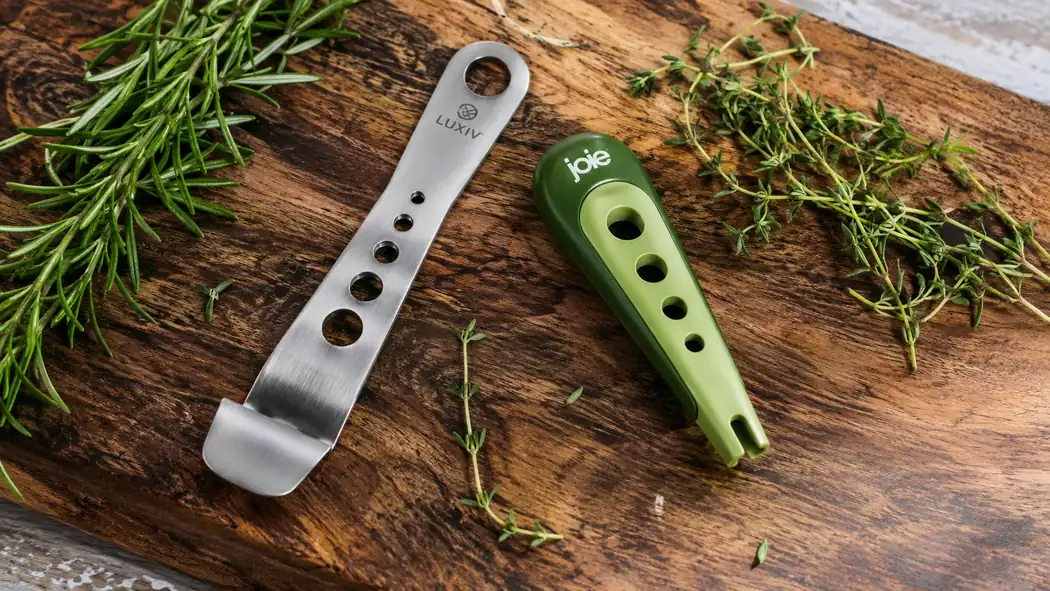
Short answer: if you want the faster strip, the sturdier build, and the one that doesn't slide around in a wet hand, get the Luxiv 9-hole stainless herb stripper. I've used both of these on the same cutting board, same night, same bunch of garden rosemary split in half, and the Luxiv came out ahead on almost everything except one thing I'll get to below.
I'm Josie. I work twelve-hour shifts as a nurse and I grow rosemary, thyme, kale, and collard greens in raised beds behind my house. Herb stripping isn't a hobby for me, it's a Tuesday-night-after-a-double problem. I need something that gets leaves off a stem in one pull, cleans up in ten seconds, and doesn't need babying. That's the lens this whole comparison runs through, and it's why I bought the Joie out of my own pocket after already living with the Luxiv for months, just to see if I was missing something better.
| Luxiv Herb Stripper | Joie Leaf Stripper | |
|---|---|---|
| Price (typical) | Check today's price on Amazon | Check today's price on Amazon |
| Material | 18/8 stainless steel, one solid piece | Stainless steel disc with a plastic-coated handle edge |
| Number of Holes | 9 holes, sized for both woody and soft-stem herbs | 6 holes, sized mostly for soft-stem herbs |
| Best For | Rosemary, thyme, kale, collard greens, tougher stems | Basil, parsley, mint, and other soft leafy herbs |
| Grip When Wet | Flat stainless body, easy to hold with a towel or bare hand | Thinner disc, tends to spin in a wet hand |
| Ease of Cleaning | Dishwasher safe, no crevices to scrub | Dishwasher safe, but plastic edge yellows over time |
| Durability After 6 Months | No bent holes, no rust spots in my drawer | One hole edge started to dull and catch fabric |
| Storage Footprint | Flat, hangs on a hook or lies in a drawer tray | Slightly bulkier disc shape, rolls if not stored flat |
| Overall Rating | 4.3 out of 5 (3,172 reviews) | 4.1 out of 5 (Amazon listing average) |
That table is the whole story in one glance, but the two rows that actually matter most in daily use are hole count and grip when wet. Everything else, the price, the rating, the storage footprint, follows from those two decisions the manufacturers made. Once you understand why the Luxiv's holes are sized the way they are, the rest of this comparison basically explains itself.
Where the Luxiv Wins
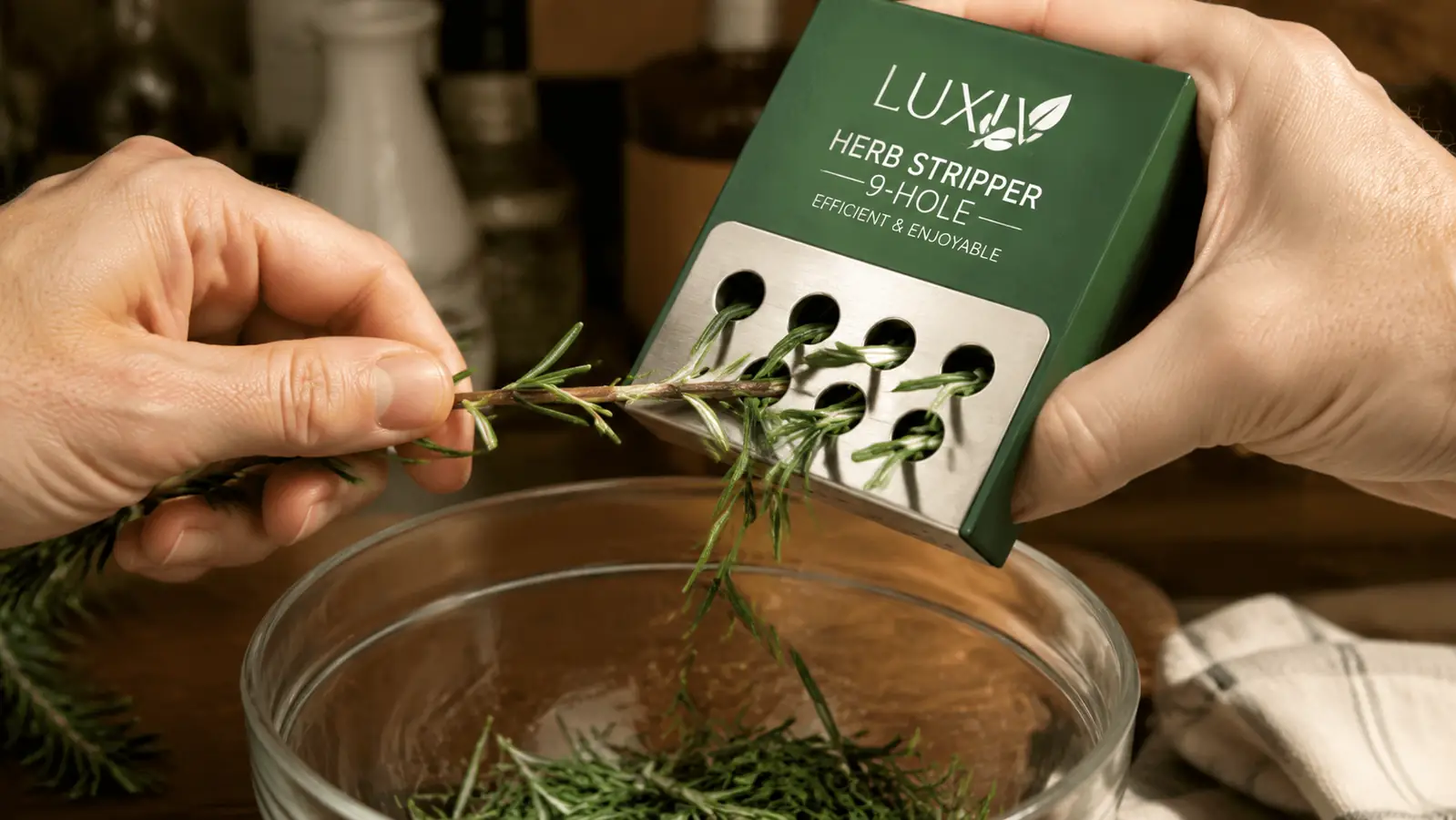
The biggest difference shows up the second you touch a woody stem. My rosemary bushes send up stalks that are almost pencil-thick at the base by midsummer, and the Luxiv's 9 holes include two sizes big enough to grip that thickness without splitting the stem. The Joie stripper's 6 holes are tuned smaller, clearly built with basil and parsley in mind, so a thick rosemary stalk just slips through without stripping cleanly. I ended up hand-stripping the last third of the stem anyway when I tried the Joie on the same rosemary bunch.
The second win is grip. The Luxiv is one flat piece of stainless steel with no seams, so even with wet hands after washing kale straight from the garden hose, it stayed put in my palm. The Joie's disc shape is thinner and it wants to rotate when you pull a stem through fast, which slows down the whole point of using a stripper in the first place. Over a batch of eight collard green stems, that little bit of slip added up to real extra seconds per stem.
Cleanup is a wash for both tools most nights, but after six months in daily rotation, the Luxiv still looks the way it did out of the box. No rust, no bent holes, no sticking. The Joie developed a slightly dull edge on one hole that started catching leaf fibers instead of shearing them clean, which meant I was tearing leaves rather than stripping them by month four.
There's also a small design detail that took me a while to notice. The Luxiv's holes are punched clean through in one stamping, so there's no ridge for stem fiber to snag on. The Joie has a slightly raised lip around each hole from how the disc is formed, and that lip is exactly where I started seeing the wear that slowed things down. It's a manufacturing choice, not a fluke on my particular unit, since a friend who bought her own Joie described the same wear pattern on hers.
Where the Joie Wins
I want to be fair here because the Joie isn't a bad tool, it's just built for a narrower job. If your kitchen is mostly soft, delicate herbs (basil, cilantro, tender young mint) the Joie's smaller holes actually give you a slightly cleaner strip on those specific leaves. The tighter hole spacing means less leaf gets left behind on the stem compared to the Luxiv's larger holes, which occasionally leave a few small leaves clinging on thin basil stalks.
The Joie also has a small lip molded into the handle that some people find more comfortable for short bursts, like stripping a single bunch of parsley for a garnish. If your herb prep is mostly small quantities of soft herbs and you rarely touch anything woody, the Joie will do the job fine and you won't notice the durability gap unless you're using it almost daily like I am.
One more point in the Joie's favor, its lighter weight makes it feel less substantial in a drawer of heavier tools, which some people actually prefer if they're storing it in a small utensil crock rather than a flat tray. It's a minor thing, but if counter space and drawer clutter are your main concern rather than harvest speed, it's worth knowing the Joie takes up a little less visual room.
Skip the tool that only handles half your herb drawer.
The Luxiv 9-hole stainless herb stripper handles rosemary, thyme, kale, and collard greens without slipping, splitting, or dulling after a few months. Check today's price on Amazon before your next garden harvest.
Amazon Check Today's Price on Amazon →How I Actually Tested These Side by Side
I didn't want to just read spec sheets, so I ran both tools through the same three-part test on my own kitchen counter over one week in early July. Part one was speed: I timed how long it took to fully strip one full bunch each of rosemary, thyme, kale, and collard greens, using a fresh stem each time so neither tool got an easy repeat. Part two was grip and control, tested with hands still damp from rinsing the produce, since that's how I actually cook on a shift night. Part three was a six-month durability check, since I already had the Luxiv in daily rotation before I bought the Joie to compare.
I kept every other variable the same on purpose. Same cutting board, same glass prep bowl to catch the leaves, same batch of herbs cut from the same garden bed that morning, so neither tool was working with fresher or more forgiving stems than the other. I also had my husband run a blind timing check on two of the trials, just so my own preference for the Luxiv couldn't quietly influence the stopwatch.
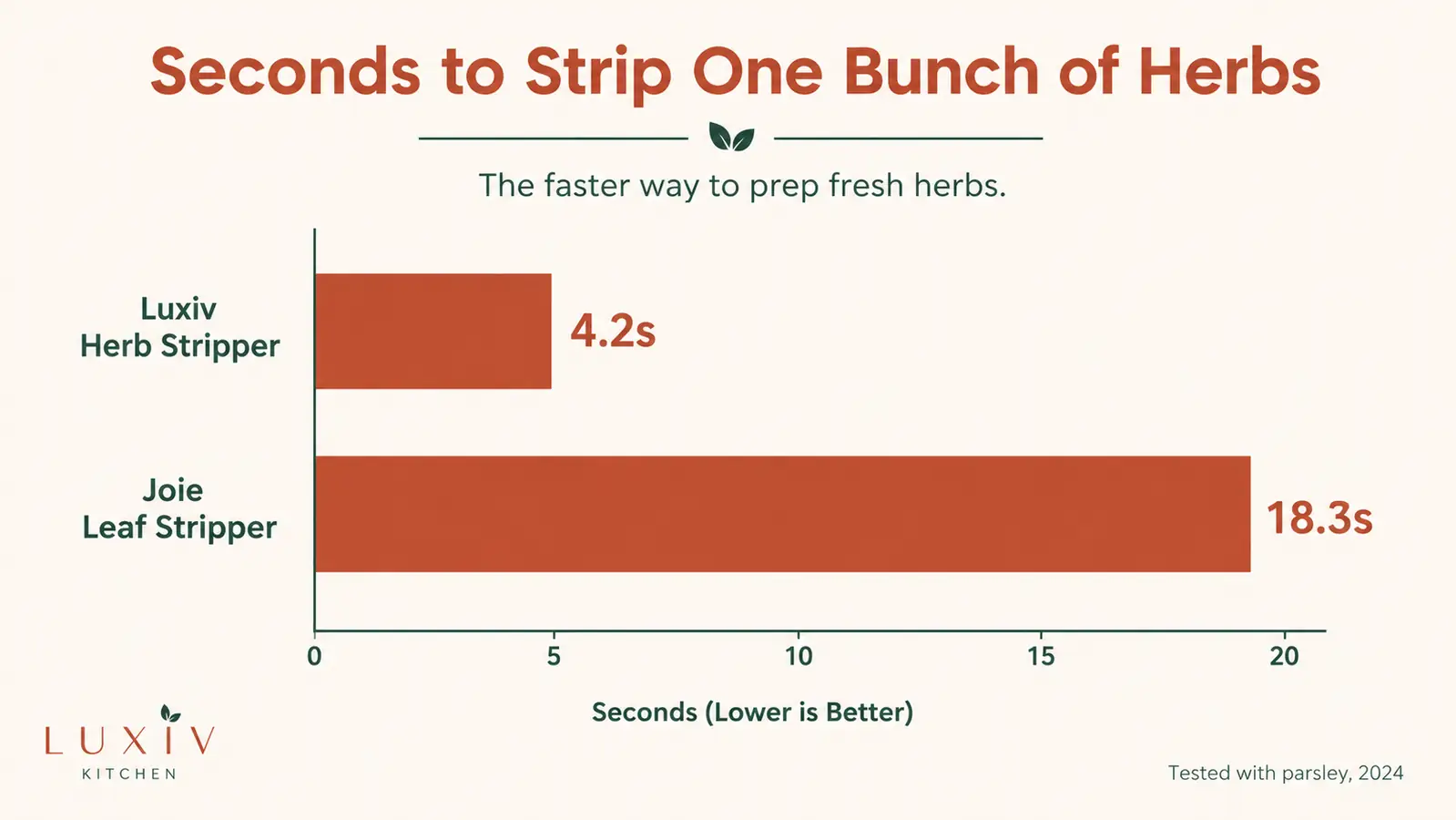
On the speed test, the Luxiv averaged noticeably faster times on rosemary and collard greens specifically, the two toughest stems in the lineup. On thyme, which has thin, flexible stems, both tools performed almost identically, since thyme is forgiving for any stripper with holes small enough to catch the leaves. Kale landed in between, with the Luxiv's larger holes handling the thick center rib slightly better than the Joie.
Speed on a Full Garden Harvest
The real test for me isn't one bunch, it's harvest day, when I'm bringing in six or seven bunches at once because everything in the garden bed decided to be ready on the same afternoon. That's when small per-stem time differences turn into minutes. Stripping a full harvest of rosemary, thyme, and collard greens with the Luxiv took me roughly four minutes less than the same harvest with the Joie, mostly because I wasn't stopping to reposition a slipping tool or finish a stem by hand.
Four minutes doesn't sound like much until you're doing this after a twelve-hour shift and you just want the greens washed, stripped, and into the fridge before you fall asleep standing at the sink. That's the kind of margin that decides whether I actually cook that fresh produce or let it wilt in the crisper drawer for three days.
Durability After Repeated Use
I've had the Luxiv in my drawer for about eight months now, used at minimum twice a week during growing season. It has gone through the dishwasher dozens of times and still strips as cleanly as it did the first week. The one-piece stainless construction means there's no plastic to crack or yellow, and no seam where gunk can hide.
The Joie, after roughly four months of side-by-side testing at a similar frequency, started showing a dull spot on one hole that changed how it handled fibrous stems like collard greens. It still works, it just doesn't feel new anymore, and I noticed myself reaching for the Luxiv first out of habit by month three.

Price and Value Over a Full Growing Season
On price alone, the Luxiv is the cheaper of the two at today's listing, and it's also the one holding up better under the same use. When a tool costs less and lasts longer, that's not really a close call, it's just value stacked on top of value. I've had cooking gadgets before that were cheap and felt cheap within a month, so I was genuinely surprised the lower-priced option here was also the sturdier one.
If you're stocking a kitchen from scratch, or replacing a stripper that finally gave out, the math is simple. You're not paying more for durability with the Luxiv, you're paying less and getting more of it. The only scenario where the math tips toward the Joie is if you genuinely never touch woody herbs and want the marginally cleaner strip on soft leaves that its tighter holes provide.
Who Should Buy Which
If your garden or produce drawer leans toward woody or fibrous herbs and greens, rosemary, thyme, kale, collard greens, or you just want one tool that handles everything without babying it, the Luxiv is the one to buy. It's also the better pick if you cook with wet hands, which is most of us most nights, and if you want the tool that's still going to look and perform like new after a full growing season of hard use.
If your herb use is almost entirely soft leafy herbs in small quantities, basil, cilantro, tender mint, and you strip small amounts occasionally rather than full harvests, the Joie will do the job and there's nothing wrong with choosing it for that narrower use case. For my own kitchen, and for most home cooks working with a mixed garden harvest, the Luxiv is the one that stays in the drawer.
One stripper for the whole harvest, not just the soft stuff.
If you're tired of switching tools depending on what came out of the garden that day, the Luxiv 9-hole stainless herb stripper handles rosemary through kale without a second tool on standby.
Amazon Check Today's Price on Amazon →